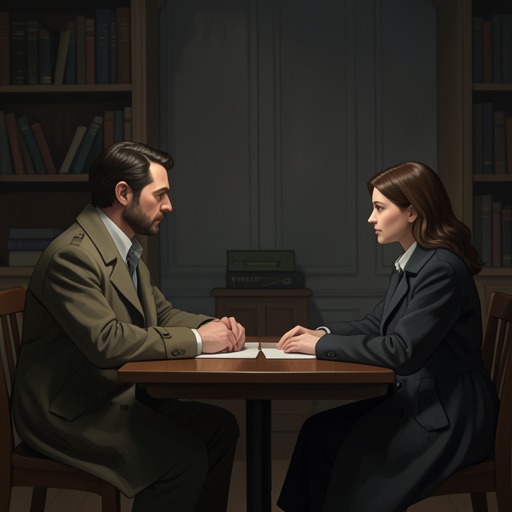
Unnamed Narrator
Breakfast at Tiffany'sThe Unnamed Narrator is Holly Golightly’s neighbor, confidant, and first-person chronicler: the person whose recollections turn an old apartment building and its vanished tenant into a story. A writer still trying to establish himself, he is drawn into Holly’s life through ordinary proximity, late-night conversations, and acts of care. His role is not to explain her into a settled identity, but to remember what she did and said—and, at the end, to keep a promise when she cannot remain.
Identity and Background
In the early years of the war, the Unnamed Narrator rents his first New York apartment in a brownstone in the East Seventies. It is a gloomy, crowded room furnished with attic pieces: an itchy red-velvet sofa and chairs, tobacco-colored stucco, and old prints of Roman ruins. Its single window looks onto a fire escape. Yet the key in his pocket gives him a sense of having a place of his own, with books and jars of pencils for the writer he hopes to become. The room establishes both his modest circumstances and the importance he attaches to independence and creative work.
Holly lives in the apartment below him. Their early connection is practical as much as personal: private telephones are hard to come by during the war, so both make frequent calls from Joe Bell’s bar around the corner, and Joe Bell takes Holly’s many messages. The narrator’s memory of the brownstone is thus bound from the outset to a small neighborhood network of rooms, calls, and repeated meetings rather than to a dramatic first encounter.
The Neighbor Becomes a Confidant
The friendship gathers force in September, when Holly climbs through his window from the fire escape to escape a drunken man downstairs. She explains that the man bites, shows the narrator the mark on her shoulder, and apologizes for barging in. Wearing only a gray flannel robe, she says the cold fire escape and his cozy room brought to mind her brother Fred, who had let her hug him on cold nights. She asks to call the narrator Fred. In that first extended visit, intimacy arrives with startling speed, but it also carries the imprint of Holly’s past and her habit of assigning people names that suit the moment.
The narrator’s response is not to reject the intrusion. He listens as Holly talks, and she comes to treat him as someone who can be trusted with stories she is not sure she should tell. When she considers telling him about Sally Tomato, she makes him cross his heart and kiss his elbow—an oath that turns a private disclosure into a playful pact. The narrator becomes a witness to Holly’s connection with the imprisoned man: she visits him every Thursday, says she would go even without payment, and describes him as a pious old man who prays for her. The confidence matters as much for its limits as for its contents: Holly chooses what to reveal, and the narrator receives her account rather than claiming authority over it.
A Writer and a Witness
The narrator’s hoped-for writing life receives an early, modest affirmation when a university review accepts one of his stories for publication, though it cannot pay him. Excited, he runs upstairs to tell Holly. She initially thinks he is seeking advice and objects to unpaid publication; when she understands that he wanted congratulations, she smiles, invites him in, and proposes celebrating over coffee or lunch. Her response shows both her practical concern about money and her capacity to recognize the achievement once she sees what it means to him.
The scene also gives their friendship a reciprocal quality. The narrator has listened to Holly’s stories; now she is among the first people to share his news. She does not simply serve as a subject for his future writing. In this small exchange, she becomes an audience for his ambition, while he finds in her a companion with whom a private success can be celebrated. Her bedroom, crowded with crates and suitcases and furnished like a place ready for departure, contrasts with his attachment to the room where his books and pencils make a future imaginable.
Names, Kinship, and Unequal Knowledge
The narrator’s relationship with Holly is marked by shifting names. She calls him Fred after her brother and later addresses him as Buster; the source of the name Cookie is not established in the available account. These names make their closeness audible, but they also signal that Holly’s intimacies are shaped by the identities she carries and assigns. The narrator is not literally her brother: the family photograph shown to him later makes that distinction clear.
When Doc Golightly arrives seeking a friend, he produces a worn wallet and a brittle, cracked photograph of seven children on the porch of a stark wooden house. He points out himself, Holly as a plump blond little girl shading her eyes, and her brother Fred as a lanky child. Seeing the child’s squinting, full-cheeked face, the narrator recognizes an embryonic resemblance to the Holly he knows and understands that the visitor is her father. The photograph supplies a view of Holly’s earlier family life that their present-day exchanges cannot provide. It also sharpens the narrator’s position: he is close enough to be given an adopted family name, yet he learns her history through other people and through fragments.
Rescue, Departure, and the Promise
During the runaway-horse incident in Central Park, Holly saves the narrator’s life. Afterward, he thanks her and tells her that she is wonderful, unique, and loved. Holly calls him a damn fool and kisses him on the cheek; his vision multiplies her face until he faints. The episode turns their affection into an unmistakable act of physical rescue and gratitude, without making their bond a conventional romance.
That same evening, newspaper headlines announce Holly’s arrest in a narcotics scandal. The public version of her life abruptly overtakes the private friendship the narrator has known. Later, as Holly prepares to leave, he goes with her and sees her search for the cat she had left behind. She runs up and down the block calling for him until a boy appears with an old tomcat and tries to sell it. Holly hesitates at the limousine, looks back toward the offered cat, and says that they belonged to each other. The narrator promises to return and find the cat and take care of him.
Holly admits that she is scared—not merely of the familiar “mean reds,” but of realizing what belonged to her only after she has thrown it away. She gets into the car and leaves. The promise does not stop her departure or resolve the uncertainty she names; it gives the narrator a task that continues beyond their last shared scene. His eventual search for the abandoned cat completes the practical force of that commitment: in a story defined by Holly’s difficulty in claiming a home or a possession, he acts on the bond she has just recognized.
Narrative Role and Significance
The Unnamed Narrator tells Holly’s story retrospectively, beginning not with her arrest or disappearance but with his return in memory to the places where he once lived. A conversation with Joe Bell revives the recollection of Holly and sets the telling in motion. The narrative therefore moves through remembered scenes, preserving the difference between the narrator’s observations and what he can know about Holly’s inner life. He can report her words, gestures, rooms, and departures; her changing self-understanding reaches the reader largely through what she chooses to say.
His anonymity contrasts with the vivid names Holly gives him. He remains the Unnamed Narrator, while in her speech he is Fred or Buster, a neighbor temporarily drawn into the language of family and affection. That contrast suits his function: he does not settle Holly into a single identity but bears witness to the shifting roles she inhabits. His own defining movement is quieter. The young man who once cherished a key to his first room becomes the friend who promises to search for another creature Holly has failed to keep. Memory, storytelling, and a kept promise make his presence consequential even after she has gone.